Monday, March 24, 2008

Easter Madness

Easter Week is known here as Semana Santa, the biggest event in the Nicaraguan calendar. Many businesses as well as all government offices and schools close for the week, as people typically take their families for a beach holiday. Unfortunately, San Juan del Sur is the prime destination for Semana Santa celebrations and upwards of two hundred thousand people descend on this little town, the crush of people peaking on the Saturday after Good Friday. Two huge, multi-level discos have been assembled out of scaffolding on the beach and much of the town has been turned into a parking lot, with fast food stands lining the sidewalks and hundreds of hawkers prowling the streets. Pounding electronic music can be heard for kilometres around, generated by several different sources, from early in the morning until a couple of hours before dawn.


A solemn religious procession makes its way through town each day carrying a statue of the Virgin Mary and there are extra masses, but for most people the holiday seems to have more to do with drinking, barbecue and lazing on the beach. Nicaragua is a nation with a very low average age and teenagers abound, the perfect fodder for the twenty-four hour party energetically promoted by beer, liquor and tobacco companies. Everyone seems to want to get in on the marketing opportunity and I noticed a truck equipped with massive speakers blaring merengue music, carrying bikini clad dancing girls and guys dressed in fish costumes, promoting a popular brand of sardines. Many of the businesses that cater to the expat community and foreign tourists simply shut down for the week rather than deal with the chaos.


Other than an occasional stroll down the beach to satisfy my curiosity, I have been holding up in my little apartment with a good book. Tomorrow the throng leaves town and I will have my first night's sleep in several days. I can hardly wait.

History Lesson

I was enjoying a drink with some other travelers in celebration of yet another spectacular sunset when Michelle, an American at our table, remarked that most of the people present were Canadian. In fact, a disproportionate number of the foreigners she had met in Nicaragua were from Canada. It was helpfully pointed out to her that Canadians love to travel and perhaps only the Australians are as prone to itchy feet. Michelle rejected this idea, however, arguing that the United States' larger population should compensate for Americans' lower propensity to venture abroad.

I offered that Canadians have a very positive relationship with Nicaragua. Many had supported the Sandanista revolution and thousands came as volunteers during the 1980's to help the country rebuild after the destruction caused during the revolution and subsequent war against the United States. Also, I cautiously observed that the perception of Nicaragua among Americans is still somewhat coloured by the Reagan era propaganda campaign that had portrayed the country as a Soviet-backed terrorist state. As a result there remains a residual prejudice against Nicaragua, a situation that the current security hysteria in the US doesn't help. In my own experience, passing through the Atlanta airport on my way here I was thoroughly searched and questioned simply because I was flying to Managua. In response to Michelle's blank look of incomprehension, I took a deep breath and elaborated.

The United States has a long and unflattering history in Latin America, nowhere more so than in Nicaragua. Domination of the Nicaraguan economy by US corporate interests goes back to the late nineteenth century and the US Marine Corp actually occupied the country, employing the same kind of brutality Iraqis are currently experiencing, for seven years starting in 1927. During that period, the Marines abducted and murdered legendary Nicaraguan nationalist leader Augusto Sandino as he was leaving a dinner in celebration of a peace accord intended to bring democracy to the country.

To insure against future popular uprisings, before departing for home the US military trained the Nicaraguan National Guard to be the most viciously effective weapon of repression in the region. For the next few decades the US appointed dictators of the Somoza dynasty, a small group of wealthy families and American corporations ruled the country as a tyrannical kleptocracy, with the full approval and support of Washington.

Finally, in 1979 a broad coalition of Nicaraguans, united behind the Sandanista National Liberation Front, forced Somoza from power after some 50,000 people had given their lives in the struggle. The United States government did not accept this challenge to their authority and in response created a counter-revolutionary force known as the Contras. Recruited, organized, trained, financed, armed and supported by the CIA, the Contras were a US mercenary force that carried out a terror campaign against the Nicaraguan people for ten long years at the cost of another 50,000 lives. In addition, US Special Forces destroyed infrastructure in the country and the US Navy mined the harbours as part of a parallel campaign by the US administration to wreck the economy.

Illegal under both international and American law, Washington's war against Nicaragua continued until the United States Congress realized that the commanders of the Contras, characterized as “the moral equivalent of our founding fathers” by Ronald Reagan, were in fact criminals, former National Guard officers and death squad leaders who were prosecuting a war against their own people primarily to facilitate the siphoning off of US gun money into Swiss bank accounts. The Reagan administration, however, chose to disregard Congress when it refused further funding and continued financing the Contras illegally with the proceeds of covert weapons sales to Iran.

When their plan was discovered, Reagan and his staff feigned ignorance and offered up a Marine officer named Oliver North as a scapegoat. After a brief stint in a country club prison, Colonel North wrote a book exonerating himself and entered Republican politics. As a result of its war against the Nicaraguan people, today the United States shares only with Libya the distinction of having been convicted of state terrorism by the World Court. Of course, the irony of a War on Terror carried out by the world's foremost terrorist state is lost on most Americans.

Peace returned in 1990 only after a war weary Nicaraguan public elected the Washington financed UNO coalition in response to a US ultimatum threatening continued economic warfare if they did not. The terms of peace with the United States demanded a roll back of social reforms and left Nicaragua with a crushing debt. Persecution by Washington continues, regrettably, and in one example financial aid and IMF loans to support the economy after Hurricane Mitch ravaged the country in 1998 were held up until the Nicaraguan government agreed to sell off its national telephone system and state oil company to foreign corporations at fire sale prices. However, generous US financing of opposition political parties could not stop the Sandinistas from being re-elected to power in 2006.

Michelle is not an ignorant or untraveled woman. She is an oncologist from Seattle who spent six months traversing the length of Africa just last year, yet everything I told her about Nicaragua came as news. Although others at the table nodded in agreement with my telling of history, it was obvious that Michelle's had stopped listening. Her response was to utter, “Huh”, turn to someone else and change the subject.

I have sometimes felt sorry for Americans, often ashamed of their country's actions and at odds with its leaders. Embarrassing as their history may be, it is Michelle's kind of willful ignorance that permits their government to get away with its crimes and will probably cost at least three more US soldiers their lives in Iraq today.

Monday, March 10, 2008

In Search of the Green Flash

image

Sunset watching is a popular activity here, typically enjoyed with a glass of rum in hand. The other night, someone at the beach bar mentioned the green flash and I was asked for an explanation of this rare phenomenon.

image

I have met two people who claim to have seen it, a brilliant green flash of light at the last moment of sunset, caused by a refraction of the sun's rays. It is said to occur only when atmospheric conditions are right and you are lucky to see it even once in your lifetime. For some individuals experiencing the green flash is an item on their life list and for others merely an excellent excuse for spending their evenings by the beach, drinking rum.

Mas Managua

I had just settled back into San Juan del Sur, but couldn't resist when an opportunity came up to travel around the country for a few days. In Managua again I had the chance to meet with Ramon Meneses, a Sandanista veteran of the '79 revolution. Like many who fought to liberate Nicaragua, he has become disillusioned with the direction that the country has taken and with current president Daniel Ortega. In response, Ramon has joined a new political party, the Sandinista Renovation Movement, in hopes of reviving the original ideals of the revolution. His opinion echoed what I have heard from several others, that president Ortega is more concerned with maintaining himself in power than with the best interests of the public.

Among other oddities, Ortega has formed a bizarre partnership with his main political rival, Alberto Aleman of the Liberal Party, a past president imprisoned for corruption and theft but then inexplicably freed by Ortega. The constitution currently forbids a president from serving two consecutive terms and it is suspected that Ortega has made a back room deal with Aleman to alternate the office between them. Since Aleman is wanted in several countries and would be arrested if he were ever to leave Nicaragua, his freedom is dependent upon Ortega's good will and presumably he will do whatever he is told, even if he is returned to office. This must just be a back up plan, since Ortega is trying to have the constitution changed to eliminate the one term limit. If he gets his way, it is possible the presidency could turn into an Ortega dynasty, as Daniel is said to be grooming his sons to succeed him.


In the meantime, corruption deepens and Ortega keeps thumbing his nose at the US by flaunting his friendships with Fidel Castro and Hugo Chavez. Venezuela supplies Nicaragua with oil and financial aid, however, the government here will not disclose how much cash they receive or where it goes, leading to suspicions that the money is finding its way into certain Swiss bank accounts.


The newest political wrinkle is Ortega's move to have all candidates for the FSLN (Sandanistas) chosen by him rather than through nominations by the party rank and file. If he gets his way, Ortega will maintain the illusion of democracy without the inconvenience of actual responsibility to the electorate.


From Managua we traveled on to Volcan Masaya, where you can drive a car up to the crater rim of this active volcano. Sulfurous gases and smoke rise out of the crater and it has been known to occasionally expel Volkswagen sized chunks of molten rock. Warning signs direct visitors to park their cars pointing downhill in case a quick escape becomes necessary and that spending more than twenty minutes at the crater may risk them being overcome by the fumes. In safety obsessed North America, no one would be permitted within kilometres of such a site.


After another day of touring through the villages and countryside it was back to San Juan for a new week of Spanish classes.

Monday, March 03, 2008

Volcano Climbing

Ometepe is an island of strange beauty sited in the centre of Lake Nicaragua. Dominated by its two volcanoes, it is shaped something like a figure-eight. Life for the local people is simple, mostly agrarian and very poor, but safety is not an issue here in contrast to the rest of the country. Many of the plantations are worker owned co-operatives, no doubt founded in the heady days of socialist experimentation that followed the revolution.


Beyond the end of the pavement, my motorcycle's speed was reduced to little more that a jogging pace by the appalling condition of the roads, made of packed dirt that turns to mud in the rainy season, evolving ruts and wholes which then dry to the hardness of granite in the dry season. Near the village of Balgue I found the Finca Magdelana, a co-operative coffee growing operation at the foot of Volcan Maderas. Starbuck's regulars may know this, but it came as news to me that Nicaraguan coffee is considered among the world's best. A couple of decades ago, visitors to the island would stop at the finca after climbing to the top of the volcano, looking for food and lodging. From that beginning, hospitality has evolved into a very profitable side business for the farm and it is featured prominently in any guide book you may find describing the island.

The accommodation at Finca Magdelena is basic, as is the food, but a night's stay and three meals comes to less than ten dollars. Other than the volcano climb, activities amount to a large selection of hammocks in which to read or nap during the day and long conversations with other adventurous travelers at night while consuming vast quantities of the excellent local rum and beer.


It was eight hours of hard work getting to the crater's edge of Volcan Maderas and back to the finca. All seven of us were covered in mud to the waist and exhausted. Unluckily, the clouds that typically surround the volcano's top had not burned off by the time we reached it, so we only had glimpses through the jungle cover of the spectacular view across the lake to the line of volcanic peaks that reaches up through the country to the Honduran border.

Hilux Envy

Traveling around Nicaragua, you cannot help noticing the overwhelming preponderance of Toyota vehicles on the roads. Not just here, but anywhere in the world where rugged reliability is valued, the Toyota Hilux four wheel drive pickup truck is the gold standard of motor vehicles.

From Mongolia to Africa and throughout the developing world Toyota owns a dominant share of the automobile market. Not just trucks, but in small cars and family sedans too, the Japanese giant is the obvious top seller. Other brands are always available, of course, but anyone here will tell you that the Hilux is their dream car.

I recall once seeing a television interview with a sheep rancher in the Australian outback who explained that his sheep station is so isolated and the climate so harsh that a breakdown could easily be fatal. When you life literally depends on your vehicle, Toyota is the only choice.

On the British television programme, Top Gear, a Hilux was crushed with a wrecking ball, drowned in the ocean and then set on fire. When it survived all of that punishment, they collapsed an apartment building beneath it using explosive demolition. The truck was still drivable. Have a look, here and here. In another episode, two middle-aged, profoundly unfit Englishmen drove a Hilux to the North Pole in a race against a dog sled. You can see it here. The Hilux is apparently also the vehicle of choice for the Taliban in Afganistan, a fact that Toyota chooses not to use in its advertising.

Sunday, March 02, 2008

Island Time

Getting through Managua the second time was a breeze. Recalling my first experience of the city, I was apprehensive about diving into the urban chaos of the capital again. Luckily, at the first gas station that I stopped at there was a helpful guy working the pumps who had a map and the blessed ability to give clear directions. In twenty minute I was through the city and back on the highway.

Having left Poneloya just after dawn, I was able to travel most of the way back to Rivas in the relative cool of the morning. With traffic light most of the way I was making good time. Just past Granada I came upon an intersection with a few houses scattered along the roadside. Slowing down to allow for any unexpected pedestrian traffic, I was thinking what a smooth trip it had been when an old man, teetering along the shoulder on a bicycle, suddenly decided to cross the road in front of me. There was no way to avoid him; my choice was to hit him and crash, or just crash. The front wheel locked up as I hit the brakes hard and the bike went down, tossing me over the handlebars. Looking up as I lay on my back, I saw the old man peddle away without so much as a glance backward in my direction. I couldn't help laughing. Checking myself for damage, no blood, breaks or abrasions were relealed. My hands had broken my fall and the right arm was sore, but it didn't feel serious. Barely a week old, my little Yamaha had earned its first battle scars. There was now a scratch on the front fender and the tip of the handlebar had been torn up a bit, but otherwise there was no harm done. I pushed it back up onto its wheels, threw a leg over the saddle and rode on.

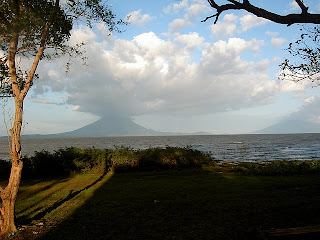
Back in Rivas, I turned towards Lake Nicaragua and the small port town of San Jorge. Ferries run from the docks there to the island of Ometepe several times a day. I spent the hour passage sitting in the sun, watching the spectacular island slowly approach, with its two volcano cones topped with clouds that looked like picture hats. It was an image out of a science fiction story.

Aboard the ferry were mostly locals returning from shopping excursions in Rivas, with a few backpackers mixed in. While wandering the decks I had the chance to meet a few expats who are working on the island. Chris Pratt is a young agronomist from the United States who is helping the local farmers increase their yields and experiment with new crop types. Tall and wiry, with curly, sand coloured hair and beard, he wore the expat uniform of t-shirt, baggy shorts and flip flops. Chris is a lanky bundle of energy and talked non-stop through the crossing, providing me with a useful overview of the island and what would be worth seeing. A cheerful Australian blonde in her late twenties, Maggie, had given up a career in marketing to take up an often frustrating ambition to build an eco-resort on the island. After two years of work, she is still a year away from opening for business, but enjoying a life less ordinary on the island.

Mayagalpa is a small and quite forgettable little port town where the ferry docks. Within a few minutes of landing I was motoring down the only stretch of paved road on the island. My right arm was aching fiercely now, having worsened steadily since my fall, and I need a place to stop and tend to it. I found a little hotel with cabins by the water and filled a plastic bag with ice at the bar for my hand. As I lay in a hammock reading and icing my wrist, I wondered just how much of an inconvenience this injury was going to be. In the end it made typing a one hand job and occupied my time so much that I have not posted here in almost three weeks.

Monday, February 11, 2008

A Bad Day


Arriving in Poneloya, I had felt disappointed by the depressing, deserted little town. By the second day I had realized just how unworkable this situation is and was considering my options. Now it is the third day and I am feeling pissed off. Getting blatantly hustled for a petty bribe by one of the local police was the cherry on the cake. Giving five bucks to the fat, grinning, cop with the bad teeth didn't bother me. What angered me was knowing that the local people, like Will and his family, have their entire lives circumscribed by men like him.


Corruption has been endemic to Latin America for so long and permeates every aspect of life to such a degree that people seem resigned to its presence. Holding any kind of public office is generally perceived primarily as an opportunity to line one's pockets. Even Daniel Ortega, the people's champion, has made himself, as well as his friends and family, extremely wealthy at the expense of his country and its people. Those photo ops with Fidel and Hugo sure help to maintain the illusion of solidarity with the masses, though.


Canadians are fortunate that our public servants lack the felonious initiative, or perhaps the imagination, to steal much. Sure, we have crooked politicians, but government corruption in Canada is having public works mow your lawn and rarely gets more ambitious. The sponsorship scandal that dominated the press for months not so long ago, sparked by the revelation that the Liberal party solicited under the table contributions in exchange for advertising contracts, was pathetically penny ante. George Bush doesn't even get out of bed for such small change.


At the local Yamaha shop I met a Nicaraguan named Richard who had immigrated to the United States at the age of twenty and joined the Marine Corp to gain his US citizenship. A year in Iraq dampened his enthusiasm for his adopted country and he returned to Nicaragua as soon as his hitch was done. Now he is frustrated with the situation here and his wife is pressuring him to move them back to the States and its modern conveniences. I felt sorry for the guy, caught between two countries, neither of which he wants to live in.


Sadly, the only way that things will ever change here is if a leader of true integrity arises to lift the publics expectations, or because a grass roots mass movement makes graft unacceptable, compelling government to enact tough laws and enforce them. The arrival of a Nicaraguan Tommy Douglas is largely a matter of luck and the other prospect most likely involves a couple of decades of selfless hard work on the part of a large group of people. Neither is a strong possibility.


At first light tomorrow I am loading up my motorcycle and leaving Poneloya. If my laundry had been dry I would have been gone today. I'll be heading for the island of Ometepe, in the centre of Lake Nicaragua, and hoping for a better experience that this one that will lift my spirits.

Second Thoughts


At the end of my second day in Poneloya, I sat down and did the math. Even though I am living here as a guest, having all of my meals at restaurants will end up costing me almost as much over the month as my Spanish classes and home stay in San Juan, so there is no real economy to be had. Cooking for myself might save a bit, or not, since it would require me to buy cooking equipment, stock staples and buy groceries, all of which I would have to haul from Leon on that awful road.


It turns out that being given my own beach house is one of those things that sounds great in prospect, but in reality has unanticipated drawbacks. It's something like having sex on a beach, which sounds romantic and for many people conjures images of Burt Lancaster and Deborah Kerr in From Here to Eternity. In practice, however, both are awkward, difficult to make work and the sand gets everywhere. The Nicaraguans I asked told me that Poneloya might not be busy, but there would definitely be other tourists and some kind of social scene. Now I find myself living alone in a ghost town prowled after dark by machete wielding muggers, a situation that fills my head with images of Charlton Heston in The Omega Man.


Even as a base of operations Poneloya poses problems. A tour to the Cerro Negro volcano leaves Leon tomorrow at four o'clock in the morning. The consensus here is that riding into the city in the pre-dawn hours would be an extremely bad idea for various reasons, therefore the only real option is to stay in one of Leon's hotels tonight and tomorrow night as well, because the tour returns after dark.


If this place has no real appeal of its own, I am not saving money and staying here does not offer any practical advantages it begs the question; why stay? I could arrange to take a week of Spanish classes in each of Leon, Esteli and Granada, with the opportunity to really know those cities, all at a cost little more than that of sitting here and struggling with the limitations of this location.

Road Warrior III

Dodging potholes on the road to Rivas, soaking wet and covered in mud, I was concentrating on keeping the little Yamaha upright and considering when I had to be where to get myself to Poneloya before dark. Then I thought, “You're riding a motorcycle across Nicaragua. Smile, you idiot!” Instantly, I forgot my schedule and concentrated on enjoying the trip.


A rain squall had delayed my departure from San Juan by half an hour, but I finally decided to just ride through it. Instead of being floured with dust as before, I was splattered with mud up to the waist, but the sun came out as soon as I was beyond the coastal hills. A short stop in Rivas was followed by a ninety minute ride on empty roads to Granada, the old capital. The oldest and best preserved Spanish colonial city in the Americas, it has many grand cathedrals in amazing pastel colours and huge, stately stone buildings with red tile roofs. I had lunch in the beautiful old quarter, but was too encumbered by luggage to have a good look around. That will have to wait for another day.


After asking at a couple of gas stations and a tourist office for a road map, I realized that they simply don't exist here. There are not many roads in the first place and everyone knows where they go, so maps are redundant for the locals, few of whom own cars anyway. Even if I could find a map, I wouldn't really be able to use it since road signs are a rarity.


Managua turned out to be just as big a headache as I had expected. Until then I had been entirely alone in the northbound lane much of the time, but the manic traffic in the capital elevated my stress level dramatically. I had to skirt the city to get on the highway to Leon and had hoped to avoid the worst of it, but without road signs I had to resort to stopping at gas stations every few kilometres to confirm that I was on course and had not been confounded by the endless series of forks, t-junctions and traffic circles I encountered.


Everyone I had talked with had told me how dangerous Managua is, roamed as it is by violent street gangs. Guidebooks say that statistically it is the safest city in Latin America, so the locals may just be exaggerating the threat out of a sense of concern for visitors. Since I was just passing through I wasn't worried, until I found myself in the midst of a gang fight. I was waiting at a stoplight when two teen aged boys appeared out of nowhere, with three more in hot pursuit. All of them were identically armed with a large knife in the left hand and a fist sized rock in the right. As they ran past, the first two suddenly decided to use me as a shield and in a moment all five were ringed around me, crouched and dancing from side to side, looking for an opening. “Screw this!” I said inside my helmet and revved the engine. Popping the clutch, I launched the bike through the intersection motocross style, chest on the tank to keep the front wheel down and toes dragging for balance as the rear wheel spun and fishtailed. I rocketed across the street, screeching tires behind me signaling my close call with the cross traffic. When I wheeled around and could look back, the boys had disappeared. Kids. After one more stop for directions I saw the outskirts of the city ahead. Drawing in a deep breath, I let it out very slowly and opened the throttle.


Leon looked interesting, but again I was not in a position to explore and made for Poneloya. Oliver, the surfing instructor, had told me that it was eighteen kilometres from Leon to Poneloya, but a forty-five minute drive. That gave me some perspective on the road conditions, but the reality was worse than I imagined. The San Juan road is as smooth as a roller skating rink by comparison. That road is badly potholed, but the Poneloya road is in a much more advance state of entropy and literally breaking up into chunks. The cheap bungee cords that were the best I could find in Rivas gave up even trying to hold my bag in place on the back of the saddle and were lost in the dust behind me. I moved the bag onto the tank, between my knees, and rode on. Even though my wrist compass confirmed that I was heading west towards the coast, I could not be sure I was actually on the right road until I crested a hill and saw the ocean a few kilometres ahead.


Poneloya is a much smaller version of San Juan del Sur, a resort town with a few hotels and restaurants. However, San Juan is a bustling place looking ahead to a bright future, whereas Poneloya is virtually deserted and has the down at heels appearance of a town whose best days are long past. When I found Will, my host's caretaker, he walked me around the corner from his little tienda to the house where I will be staying and showed me around. It has the feel of a big family cottage in Moskoka closed up at the end of the season, albeit one with Mediterranean architecture and a concern for security. There are about four thousand square feet of space spread over two floors. The lower level is a huge enclosed porch with a kitchen and bathroom, its walls made from a lattice of cast concrete blocks to a height of seven feet, with another four feet of horizontal wooden louvers above. The second story has a wrap around balcony with four large, high ceilinged bedrooms in the centre, sharing two spacious bathrooms. Other than the most basic furniture there is absolutely nothing in the house, presumably to give thieves no temptation. I'll have to pick up toilet paper tomorrow. You can easily hear the waves crashing on the beach, something less than a hundred metres from the front door. Similar vacation homes, in widely varying sizes and states of repair, line the beach front for a kilometre and seem to comprise the majority of the town's buildings.


Will recommended supper at the only worthwhile restaurant in the area, in a small hotel down the beach in the little town of Las Peñitas. He strongly and repeatedly advised me to make it back before nightfall and stay in the house at all times after dark. Excepting the Easter and Christmas holidays when it fills with Nicaraguan visitors, Poneloya is nearly empty the rest of the year. Criminal activity appears to be the primary reason. There is a police station in the town, but it is purely a nine to five operation, giving the muggers free reign through the night. This danger may also be exaggerated, but it hardly matters since there is really no nightlife of any kind. Inexplicably, several of the restaurants were open the evening I arrived, completely empty with the few staff members on hand playing music on their sound systems and watching tele-novellas. It looks like I will be getting to know the road to Leon very well.


After an good meal in the beach front restaurant I returned to the house to watch the sun go down. It's many years since I last smoked a cigar, but I am not without a sense of occasion, so I lit up the Cohiba that I had bought on impulse for a buck. Pouring myself a glass of the superb local dark rum, Flor de Cana, I settled into a rocking chair on the balcony to savour the moment. A cigar can last a good long time and before I had finished mine the sun set, the colours faded, the stars came out and night fell. As I took it all in I recalled that it was a month to the day since I left North America.


C'est la Vie

My last day in San Juan I rose early for a run. In the shower afterwards I watched as a large brown scorpion climbed out of the drain, strolled casually around the perimeter of the stall and then exited the way it had come.


So many people had talked about the transcendent experience of riding a wave that I had to at least give surfing a genuine attempt. For a few dollars I was able to get a perpetually smiling local pro surfer, Oliver Silos, to take me out to a local beach with reliable metre high waves and coach me through the basics. It took me over an hour of falling off the board and then blowing salt water out my nose to be able to consistently catch a wave and get up on the board at least than half the time. Skimming along the face of a wave on a surf board really is a tremendous sensation, but I left the beach thinking that surfing is a sport I am destined not to love.


Surfing reminds me of downhill skiing, which also was fun and easy to learn, but the half hour wait in the lift line followed by a long, wind whipped ride to the top, all for the sake of a thirty second glide to the bottom, was more than my very limited patience could tolerate. Likewise, being propelled towards the beach by an elemental force of nature for a few brief seconds just wasn't worth the long haul back out to the line after every ride to wait for a usable wave. C'est la vie.


Monday, January 28, 2008

Turtle Party

After dark it is pretty quiet here, so around nine o'clock yesterday evening I joined a lesbian couple from California for a night trip by Jeep to a nature reserve where sea turtles come to nest. Doing anything is fun with Patricia and Marianne, the life of whatever party they can find or get started.

The full of the moon had just passed and there was still some activity in the nursery. At the height of the season, as many as twenty thousand turtles will come ashore each night. Using only red coloured pin lights to avoid disturbing the animals, we saw two metre-long females climb out of the sea to the dry sand above the tide line and use their fins to dig nests into which they would deposit about a hundred eggs. Adult turtles returning to this beach are wary of predators as they leave the water and cannot be approached but, once they are committed to laying their eggs, they will not stop and it is possible to get within inches.

Our guide discovered several nests and we watched the hatchlings, each about five centimetres in length, break out through the sand and crawl slowly to the sea, twenty to thirty coming from each nesting site. We had to step cautiously to avoid the hundreds of tiny, struggling creatures. There are always a few nests that miss their timing and emerge in daylight. To save these hatchlings from circling seabirds volunteers walk the beach, collecting them to be kept in water until dark. About a hundred of them were carried down to the waterline in a basket and we released them into the relative safety of the ocean.

Some species can live up to two-hundred and fifty years, but perhaps only one individual in a thousand will make it to adulthood. In spite of the many reserves like the one here and conservation programmes, all but a few varieties of sea turtle remain endangered by extinction.

Saturday, January 26, 2008

Alternate Modes

Various minor obstacles are still preventing me from closing the deal on the purchase of a motorcycle. Lacking a vehicle of my own, I have needed to explore alternate modes of transport. Last week, during an evening at the local expat hangout, Big Wave Dave's, I shared a conversation with one of the town's many hotshot real estate agents. A few day later Mark called to offer me a tour of several beach front properties to the south of town in his Toyota 4x4 truck, assuming me to be a potential buyer. Admittedly, I did not disabuse him of this notion when I accepted his generous offer. A graduate in Latin American studies from Atlanta with fluent Spanish, Mark is twenty-six years old and has lived here for eighteen months, enjoying life's sweet spot of being in the right place at the right time. If he is not a millionaire by his thirtieth birthday, we will both be very surprised.

At a little waterfront bar I let Mark buy me drink and give a short tutorial on property development in the area. Should you be interested, houses facing onto the beach are already over $400,000 and climbing, although serviced fifteen hundred square metre lots on a hillside overlooking a spectacular stretch of sand can be had for as little as $55,000 and for about $100,000 more the developer will build you a nice, two bedroom white stucco hacienda with red tiled roof. At the moment, a rutted dirt road runs along the coast past these developments, reaching ten kilometres down from San Juan del Sur to the Costa Rican border. If it is paved within the next few years, as people here expect, prices are likely to jump.

image

The smart money is already moving on, I am told, buying cheap in the undeveloped coastal areas towards the northern border where serious building is still five to ten years away. Another interesting new wrinkle is the commercial development that is starting to appear in the town centre of San Juan del Sur. Some parties obviously believe that all the money and people flowing in will soon make new shops, services and restaurants a viable proposition.

Two things have caused the market to stall somewhat in the past year. The first is the Sandanistas' return to office. Americans feel a residual paranoia regarding Daniel Ortega left over from the Reagan era and still harbour suspicions that this country could become 'Cuba lite'. The reality is that many senior party officials are among the wealthiest businessmen in the country, with vested economic interests. It is hard to imagine them trying to revive the kind of hard line socialism that collapsed in the rest of the world almost two decades ago. The other issue is the real estate meltdown in the US that has property owners scrambling to unload assets here so they can pay down debts at home. Unencumbered by either ideological baggage or a depressed housing market, Canadians appear unconcerned and are still actively shopping.

The next day, I joined a half dozen others to rent horses and ride five kilometres south of town to a beach inaccessible by vehicle. I was the one who naively raised his hand when the vaquero asked if anyone knew how to ride and drew a feisty little chestnut mare, Tintero, full of energy and eager to run.

A tight hold on the reign held the horse back to a steady canter along the rutted dirt track, but I still made the beach a good twenty minutes ahead of the others. Once there, I eased my grip and we galloped along the firm sand near the waterline. Turning as we approached the rocky outcropping at the end of the beach, I urged Tintero on for another run, but as she got up to speed I suddenly found myself tumbling through the air as the world spun around me. Kicking loose from the stirrups as I fell, I struck the ground head first into a pile of loose stones. Rolling onto my back, I saw Tintero standing a few metres away, looking at me curiously. The impact had knocked the wind out of me and I struggled for a moment to fill my lungs. After the usual check to see that all systems were functioning and all of my blood supply was still on the inside, where it belongs, I slowly got to my feet and went to discover what had happened. The saddle was hanging off to one side and lifting the stirrup confirmed the obvious, the cinch had come loose. Normally, the cinch is held tight by a buckle, but this one was a simpler arrangement only secured by a half hitch in the leather strap around a D-ring. There was nothing I could do other than shake my head in wonder and rub the growing bump on top of it.

The beach was a beautiful and deserted half moon bay, with sets of five foot breakers rolling in. With Tintero tied to a fencepost, I swam out to catch the waves as they crested, body surfing into the shore. After a couple of hours my shoulders were starting to sunburn, the adrenaline was wearing off and sunset was closing in. Besides that, a boatload of surfers had shown up and one came within inches of decapitating me with his board. It was time to go. The ride back aboard Tintero was uneventful, although I anticipate an ache in my thighs tomorrow.

Wednesday, January 23, 2008

Road Warrior II

This week so far has been busy, but surprisingly uneventful. With only until the end of the month to get a handle on Spanish before having to fend for myself, I have been concentrating on my studies accordingly.


Friday I will go to Rivas and finally buy a motorcycle. Buying used might have been cheaper but, after canvasing my few local contacts, I realized that a new bike is the only way to go. With an extended family or large social network, finding a second hand bike might be possible locally, but lacking either I would be in for a long and arduous undertaking. There is no craigslist.com for Nicaragua. After imagining myself making the four hour trip to Managua, then trying to track down possible sellers with my fumbling Spanish in a city without street names or house numbers that was put back together in ad hoc fashion after the last big earthquake in 1972, I thought it better to go to Rivas and find a dealer.


Honda and Yamaha are represented here, as well as many other brands I don't recognize. Several Chinese makes are available with a wide variety of odd names like Kayak, Freedom and RC Moto, all of which appear remarkably similar and are most likely unauthorized copies of Japanese designs. Indian brands Bajaj, Quasar and Discovery are also here. Road bikes and dual purpose machines with off-road capability, all in the 100cc to 250cc engine capacity range, are the most common. One suggestion I received was to buy a 'Chonda', assembled in China from genuine Honda parts. A few hundred dollars less than the real thing, but I would need to have a mechanic “tighten it up” before riding.


Nicaragua's roads will be a challenge on two wheels, but the locals manage so surely I can adapt. When a man rolls by riding a 100cc motorcycle on these roads with his wife on the back, a baby in her arms, and a toddler perched on the gas tank, you can't help but admire the obvious riding skill.

Saturday, January 19, 2008

Land Rush

The several real estate offices in town indicate the pace of development here, with at least half a dozen scattered around the downtown area. All are American owned an operated. The project brochures are impressive and smiling salesmen repeatedly assured me that San Juan del Sur will be unrecognizable within five years, their enthusiastic tone implying this would be good thing. The unsettling aspect of these projects is their similarity. Poor, uneducated peasants are paid a pitifully small amount for their land on which houses and condos are then constructed for wealthy foreigners within walled compounds with their own stores, infrastructure and security forces. These self-contained developments are designed to ensure the inhabitants of minimal interaction or involvement with the surrounding community and will make a negligible contribution to the local economy. The developers will realize millions, Nicaraguans will only ever see the inside of these places as servants and San Juan del Sur will still be struggling for money to keep the town's utilities running.


Here is an alternative scenario. Imagine for a moment that a foreign government aid agency or NGO took an interest in this place and acted to see that the latent economic value being developed here actually benefited the local population. The budget necessary would be quite small as aid projects go. Groups of local land owners could be organized to form co-operative corporations that could then make deals with developers or create their own development companies. A loan guarantee from a foreign government, which involves no actual expense, could give the town the ability to raise money through a sale of bonds at the lowest possible interest rate, with the cash going to improve the local infrastructure. A condition of the loan guarantee would be independent oversight of all spending of the funds raised, eliminating any possibility of money going astray. Instead of gated compounds, new construction could be integrated into the existing community, creating more tax revenue, inviting retirees and owners of vacation properties to become a part of the local culture and giving them an interest in the town's future. The profits from sales of the homes eventually constructed would be shared by the original landowners, potentially vaulting thousands of people here into the middle class in a matter of a few years.


It is just an idea, but one I am going to investigate. A little research should provide me with the contact info for the Canadian International Development Agency and some faculties of international development studies at Canadian universities. Why not try?

Friday, January 18, 2008

Road Warrior

Viewing the traffic on the San Juan del Sur to Rivas road from a distance, you might wonder if the local drivers are in the habit of dropping a lid of acid before climbing behind the wheel. The cars appear to be weaving erratically across both lanes and both shoulders, slowing and accelerating at random intervals. Only if you were up close would you see that the road is actually a minefield of potholes, some deep enough to break an axle, through which the cars must thread their way.

I made the journey in a 'taxi collectivo' that only leaves when every seat is taken. The trip to Rivas takes forty minutes and costs the equivalent of $1.50. My driver was pushing his little Toyota hard, at some points going along the very outside of the shoulder, engine screaming, with cool disregard for the ten metre drop just beyond the crumbling edge of the asphalt. From the disdainful look I received he seemed to take it a comment on his skills, or perhaps my lack of machismo, when I buckled my seatbelt. The next ten kilometres were especially rough and everyone in the car, veterans of this trip, rolled up the windows in unison to keep out the billowing clouds of ocher coloured dust rising from the road surface. Once we made it out to the Pan-American Highway and relatively smooth tarmac, I could open my window and let the breeze blast the beads of sweat from my forehead.

Kodak Moment

After Spanish class, the students and teachers climbed into a van and drove to Rivas, a larger town about a one hour drive inland. There we stopped at a supermarket to buy large quantities of candy, soft drinks and ice cream. Back on the street, we found a store a few doors down selling piñatas and bought a huge, red one in the shape of a dog. Once we had loaded the dog with candies the van took us to the shores of Lake Nicaragua and an orphanage operated there by a U.S. based baptist ministry.


Forty shouting, jumping little children greeted us while eying our presents with greedy anticipation. The piñata didn't last beyond its sixth assailant, a tiny boy with the swing of Barry Bonds. As it contents spilled onto the floor, the kids swarmed the scattering goodies, pulling up the hems of their shirts to make baskets for their loot. I've seen unfortunate children before in heartbreaking circumstances, so it was a special joy to see these happy little ones with their bright, smiling faces. The place has a good feeling to it that makes you believe these kids are well cared for and truly loved. Its location is certainly gorgeous, with geese, dogs and pea hens wandering the grounds. There was dancing, games were played and many pictures were taken. Outgoing ones who reached up their arms were picked up and held while shy ones had their nervous tears wiped away and were gently encouraged to join in.


I discovered that some of the children resident there have been orphaned and others have been abandoned, a situation that has sadly become more common in recent years, since the government outlawed abortion. Oddly, Nicaragua is one of only three countries in the world in which ending a pregnancy is illegal under all circumstances.


On the way back I spoke with a newly arrived student, Laurene, a middle-aged earth mother type who owns a store on one of B.C.'s channel islands, selling handicrafts to the tourists. She is in town for a couple of weeks with her daughter, Mandela (yes, really), visiting her two sons who are surfing real estate agents, or perhaps real estate selling surfers. The sons could be the local contacts I need to help me purchase a motorcycle and Laurene also informed me of a local dance teacher who gives private salsa classes for $20 per week. Lorene has invited me to visit the house where her family will be staying next week on Ometepe, the island in the centre of Lake Nicaragua crowned with two volcanoes. My calendar is filling up.


Friday, January 11, 2008

Fin de Semana

Fortunately, this town is too small for the cultural peculiarities of the place to be masked by a thin veneer of tourist development. Last night, a truck drove through town while the driver recited on loudspeakers the eulogy of a local woman who had just passed away. It's was a kind of open air memorial service with the entire population in attendance. This afternoon her casket made the trip to the cemetery in the back of a white van, along the main street with at least five hundred people walking behind.


Wherever I go, good food is a priority and the meals here have been simple and tasty, made with love and the freshest ingredients. Each morning pickup trucks full of fruit and vegetables roll in from the countryside, stopping for any housewife who steps out to the roadside. Although a small supermarket has just opened, it presents only a modest threat to the dozens of tiny grocery stores that dot the town, as its selection is underwhelming. When I went over to have a look, the sound system was playing Alvin and the Chipmunks singing in Spanish to a conga beat. It makes me giggle.


My first week of Spanish classes has ended and I am coming to terms with the scale of the challenge I have taken on. How do you achieve reasonable fluency in a language in only four weeks? The first few days gave me an understanding of the teaching method and pace of the programme. As well as reviewing my notes each night, I have begun adding fifty words to my vocabulary and translating a page of the local newspaper each day. I am hoping that, over the month, that should give me at least 1,500 words and a good understanding of the grammar. Guessing where the instruction will go next allows me to prepare in advance for the next day's class. Still, even rapid progress feels painfully slow.


This weekend will be a quiet one. Despite the heat, I have managed to catch a cold and will be giving myself the next two days to get over the worst of it. The volcano climb I had intended is a difficult ascent and the trip to the top and back down takes ten hours of hard effort, so best to wait until I am feeling more able. Maybe surfing deserves another try.

Tuesday, January 08, 2008

Back to School

My first day at Spanish class. Six students arrived to be introduced to the instructors; three Canadians, two Australians and a Finn. I drew Margarita, a beautiful twenty-six year old Latina with a megawatt smile. Half of the instruction is the old-fashioned but necessary rote learning of conjugations, etc. The rest is simple, halting conversation, picking up words and pronunciations as you go. None of the teachers speak more that the most basic English. From first impressions I think I will make rapid progress over the next four weeks.

Before coming here I had worked assiduously for months with a computer-based language learning programme that billed itself as the fastest possible way to get results. I got nowhere. Three days here has given me more Spanish than all the time I wasted on the computer. .


The school organized a hike this afternoon to the top of a headland just north of town. Tourism only started here about four years ago, but development is accelerating and the changes are easy to see from a vantage point. A luxury hotel with attached condominiums is nearing completion on the hills above the town. At the north end of the beach and separated by a stream from the main part of town is a neighbourhood of grand houses and gated communities surrounded by high walls, some topped with razor ribbon. We walked along its well paved streets and I was told that all of the services here are up to date and reliable, unlike the rest of town. The expats I have met or overheard gripe about the government having the country in a tailspin and the limitations of this place, but in the next breath invariably boast about how incredibly cheap they are able to live here.


Local people regard Daniel Ortega as the people's president, concerned with the plight of the impoverished majority of Nicaraguans. On the hike I spoke with a New Yorker who is shopping for property here. Beyond the headland was an area of vast private villas he described as “the Beverly Hills of Nicaragua”. Half an acre with a spectacular ocean view goes for about $100,000. Our climb took us past a series of developments, each one more extravagant than the last. Reaching the top and looking down at the town, with its crumbling streets and decrepit buildings, it was easy to understand why the last election put Ortega back into office.

Sunday, January 06, 2008

Eyes Wide Shut

That my quiet life in Canada might have dulled my wits had concerned me. Now I realize that my apprehension was justified. Yesterday, I decided to have a beach day and took a water taxi with a few others to a secluded spot about forty minutes north of town. It was a beautiful length of snow white sand and perhaps only six other people were there. After lazing about for a couple of hours, I got restless and went exploring. A few hundred metres along the shore I found a surfing school and spent some time watching the students get up for two second rides on one metre waves before falling off. It was a cool little scene with a bar and funky music playing from loudspeakers. With an hour left until the water taxi returned to pick me up, I headed back to the main beach with a group of others.

My mistake was in stopping to take a picture. That minute made all the difference. The rest of the group had disappeared around a corner. I wish that there were some pictures for this post, but at that moment three masked men carrying military combat knives emerged from the trees lining the beach and charged me. I turned reflexively and tried to make for the water, but they had picked their spot. Ten metres of slick, sharp rocks separated me from the sea. Attempting to run over the first stretch of rock, I immediately fell and gashed my knee. It was a stupid move and they were closing fast. I had a knife, but it was buried deep in my bag. I had taken it out of my waistband before I had gone swimming. Even if it had been in my hand, I would not have drawn it. Three-to-one are lousy odds in a knife fight and there was nothing on me that I was willing to die defending.

Flinging my backpack to the right, I broke left towards the main beach. There was a wad of cash in my pocket and I did not like the prospect of being searched for it. Glancing back as I accelerated, I saw them hesitate. It was enough. In that single second I had a ten metre lead and was at a full sprint on the firm sand along the waterline. They didn't bother to follow. Thirty metres further on I rounded a corner and ran into ten surfers headed in the other direction. After stopping to warn them, I limped back to the main beach to await my boat. All I had lost was my camera, a really cool Oakley backpack and a fascinating book on political economy by John Ralston Saul. I can live with that. Even if the camera had not been smacked on the rocks and doused in sea water, it is useless without the cables and I doubt that they have enough English to read the book, so all the thieves get for their trouble is a backpack and enough coins to buy a Coke.

Landing back in San Juan del Sur, I found my driver, Victor, and went to the police station. One officer took the details down in longhand, then filled out a report on an old Remington typewriter while two others watched Die Hard on television. How quaint. There is no chance of recovering my possessions, but perhaps others could be warned. They told me a major police operation on those beaches is just about to get underway.

I cleaned the wound on my knee, applied disinfectant and bound it. It will be fine in a couple of days, but my plans to go dancing with the two English girls I met had to be scratched.

The harsh reality is that cheap holidays to places like Cuba, the Dominican Republic or Nicaragua are made possible by the poverty of their citizens. It is comforting to think that tourism is helping the economy and not just taking advantage of the people's misfortune, but honestly it does both. Inevitably, for some the wealth of visitors in the midst of their poverty will make crime too attractive an alternative to resist.

Our own security is inextricably tied to the well-being of people in countries like this one and not just safety from robbery while on vacation. Drug cartels and organized crime organizations that prey on our society are enriched, empowered and given safe haven in poor countries where they can take advantage of people's desperation. The violent Jamaican street gangs in Toronto are a product of the crushing misery in Kingston's slums. It is ironic that none of the U.S. politicians ranting against illegal immigration or the drug trade are proposing the only rational solution with any hope of success; massive, Marshall Plan scale investment in Mexico. My language school here was chosen mainly because the proceeds go to community projects. I am trying to contribute as I am able.

Some lessons need to be learned the hard way. I had heard of robberies on the southern beaches, but had been told that those to the north were safe. I should still have been on my guard. Making the right move only after making a truly bad one could have been my undoing. From today I will have my eyes wide open.

 
Clicky Web Analytics